AI continues to surprise me

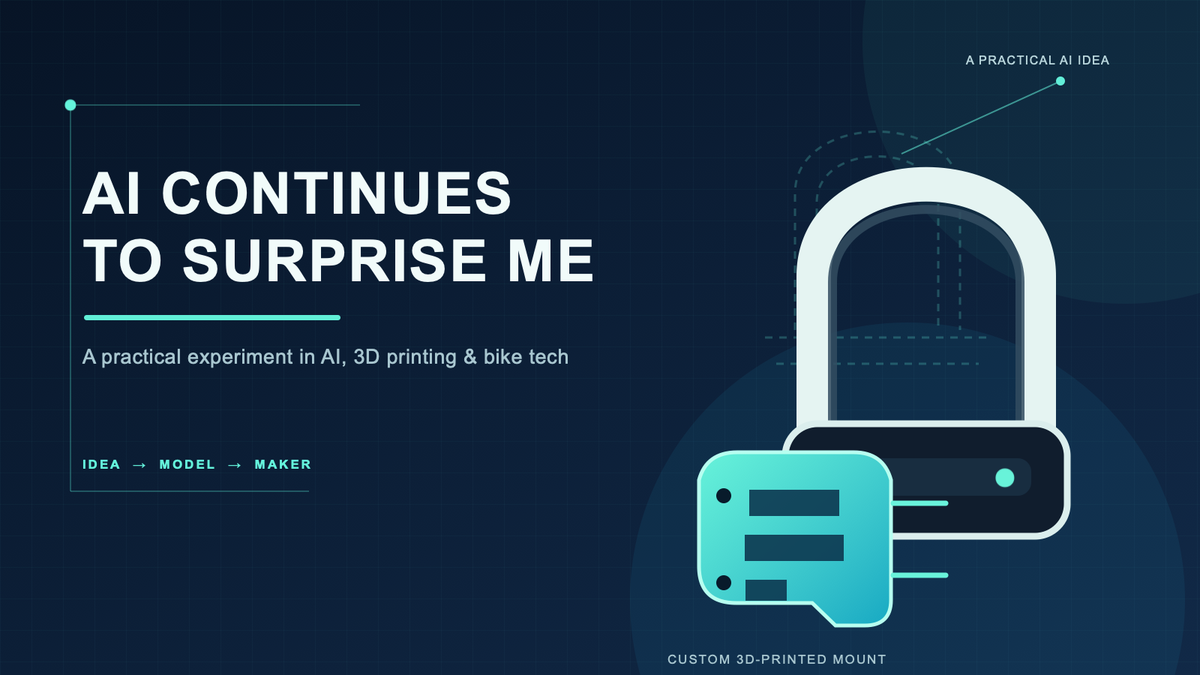
A small aside in this post: I’m currently looking at buying a new bike and, unfortunately, with the world being what it is, I also need to buy a decent lock — ideally one that means it is still there the first time I leave it outside a coffee shop.
After doing my research, I settled on a lock. The only problem was that it did not come with a mounting bracket for the bike frame. I asked an AI agent to scour the web for a suitable solution, but there was nothing that really stood out. Then, unprompted, it suggested that it could design a printable mount instead.
About five minutes later, I had a 3D model open in my printer slicer.
I do not yet know whether the finished part will work perfectly in the real world, but it certainly looks the part. The fact that an AI agent could take a practical problem, recognise that I have access to a 3D printer, suggest a possible solution, and then generate a usable 3D file from scratch genuinely blew me away.
This is where I see AI being particularly useful. I can design simple parts in FreeCAD, but I am not a designer and I would struggle to model something like a lock mounting bracket from scratch. The remarkable part was not simply that the AI could create it; it was that it suggested the idea in the first place, based on the context it already had about my setup. If it ends up saving me money, time, or both, then that is an excellent bonus.
This is not the first time I have been genuinely staggered by the capabilities of AI.
Recently, I needed some custom firmware for a Cardputer ADV — a tiny handheld computer based on an ESP32. Although I have coding experience, development for ESP32 devices would mean working with languages, toolchains, and hardware-specific libraries that I do not know particularly well.
Instead, I gave an AI agent a specification of what I wanted the device to do. It produced working firmware for the Cardputer. It took a couple of iterations to get everything exactly right, but it was one of the first times I remember being properly impressed by what AI could achieve in a practical sense.
Actually, that is not entirely true. I think the first time I was truly impressed was the first time I used AI at all. But setting aside that initial wow moment, producing fully working custom firmware in a matter of minutes was something else entirely. It turned an idea that might otherwise have sat on a to-do list for weeks into something tangible almost immediately.
More recently, I have started experimenting with AI-powered Kanban boards. I have only used them a handful of times so far, but I can already see their potential to save a huge amount of time — or, at the very least, to take care of the tedious technical chores that often get in the way of a project.
Things such as configuring DNS records, setting up reverse proxies, and getting a website from “this should exist” to “it is live and working” are not always difficult, but they can be fiddly and time-consuming. Being able to describe the outcome you want and have an agent help work through the implementation is incredibly useful.
I plan to explore this subject in more depth in a future post, once I have had more time to experiment and put these tools through their paces. There is plenty of hype around AI, and it is important to remain realistic about its limitations, but practical examples like these are where it starts to feel less like a novelty and more like a genuinely useful tool.
Anyway, just a short post this time. Until next time.
Note: Whilst I wrote this article, AI was used to proof-read and tighten things up.