My AI journey

My AI journey started, as I imagine it did for many people, with ChatGPT. Towards the end of 2022, the IT press seemed to be talking about little else but the remarkable new technology that promised to revolutionise everything. Its ability to understand natural-language prompts and hold back-and-forth conversations created a real buzz.
I remember being impressed by ChatGPT at the time. It was not the first large language model (LLM), but it was the product that brought LLMs firmly into mainstream public conversation. Looking back, it is easier to see its shortcomings: it often hallucinated — or, more simply, got things plainly wrong — and it had a fixed cut-off point for its knowledge. Ask it about sufficiently recent events and it simply would not know. Even so, it was hugely impressive.
Since then, AI has progressed at an astonishing pace. There are now dozens of providers, each offering multiple models and all competing to build the most capable and useful AI systems.
Over the past few years, I have tried the main models, including ChatGPT, Claude, Gemini and others. Each has its strengths, but in my experience they all perform well and have improved steadily — and quickly. Access to the internet, for example, has made them far more useful. Want a summary of a YouTube video or the day’s news? No problem. Need help choosing an air fryer on Amazon? AI can help research the options, compare product descriptions and reviews, and narrow down the choice.
For me, in my line of work, AI has been indispensable, and my productivity in certain areas has increased substantially. One example is XSLT. XSLT is not my strongest area, and I use it infrequently enough that I have never fully learned it. I can cobble together XSLT using Google and my least favourite website, Stack Overflow — and do not get me started on Stack Overflow — but AI can generate a useful starting point in a fraction of the time.
It is not always correct, but a few iterations will usually get me to what I need. I have also noticed the results improving as the models improve. Reducing the time needed for a task from a couple of hours to a couple of minutes makes a real difference when a deadline is looming.
At first, I tended to use AI as a DuckDuckGo substitute, although I still often found myself gravitating back to conventional search engines more out of habit than anything else. I still use DuckDuckGo for certain things, such as finding the direct link to a specific website, but for anything more involved than a basic search, I now naturally reach for AI.
I have also moved on from simply using the web-based ChatGPT and Claude interfaces, which I suspect are what most people picture when AI is mentioned — particularly those who are less technically inclined. I now use agentic AI alongside persistent-memory features to improve how I use AI and to preserve context across multiple conversations.
I will go into that in more detail in a future post, but investing time in setting up the relevant systems and configuring them to work the way I want has improved my experience with AI far more than improvements to the underlying LLMs alone.
Given how much AI has improved in such a short time, I am genuinely excited about what the future holds. That said, AI use should always come with an element of caution. AI systems can still hallucinate, produce confidently incorrect answers and make mistakes that sound entirely plausible. We must apply critical thinking to their output and avoid placing unquestioning trust in AI-based systems.
I have AI monitoring my home network and have given it the access it needs to fix certain issues autonomously. However, I have guardrails in place — and with good reason. The fact that AI can already perform the tasks it does still blows my mind.
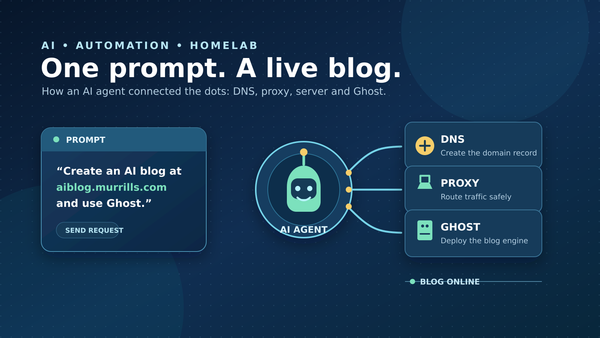
I will go into more detail in a future post about the systems that make this possible. However, being able to prompt my AI to create a blog site — and have it identify the relevant Docker container, start it, then create the DNS records and reverse-proxy entries needed to make it publicly available, all without my intervention — was a genuine glimpse of what the future may hold.
And of course, this post was proof-read by AI ;)